|
|
Archive for November 2008
30th November 2008, 06:41 am
Too often, when reading books to children we skip the dedication. In the case of Nathan’s Hanukkah Bargain by Jacqueline Dembar Greene I would advise against it. It reads, “Affectionately dedicated to all our Grandpas, because they always understand. – J.D.G.” Surely, the 9-12 year old target audience wuold understand it. The multidirectional affection shows up throughout the pages. Grandpa is shown as wise, warm, understanding figure both in text and in Steffi Karen Rubin‘s three-tone pictures. In return his grandson Nathan respects him and inspired him. In his search to find the perfect menorah for Hanukkah he could buy with the five dollar he saved they set out shopping. The first few shops had lots of options, but none of them was right. After Grandpa shares his childhood memory of bargaining with peddlers, Nathan takes the initiative and talks down the price of the kind of Hannukah he was looking for at an antique (or thrift store if you wish) store. They return home with the great experience, a new skill, some bonding memories and last but not least the object they set out for. Don’t we all wish for this kind of grandpas and days?
27th November 2008, 06:07 am
I don’t feel the need to write a better summary of Jeremy’s Dreidel by Ellie Gellman than the official one-liner, so here it is: Jeremy signs up for a Hanukkah workshop to make unusual dreidels and creates a clay dreidel with braille dots for his dad, who is blind. This story is told on 23 pages of the 32 pages. What is missing from the above description is Jeremy’s hesitation, the class’ acceptance, the classmates’ projects, the beauty of Judith Friedman‘s illustration and the heartwarming feeling you get when you read the whole story with or to your 4-8 year old children. What’s even more fun is the instructions ate the back on how to make some untraditional dreidels creatively, The last pages of the book tell you how to play the game with them and even shows you the Braille letters for what goes no the dreidels: nun, gimal, hey, and shin
25th November 2008, 10:36 am
Davey in David Gantz‘s Davey’s Hanukkah Golem live in a modern city. His grandfather though tells him the centuries old story of how the Golem protected the Jews in Prague. On the first night of Hanukkah gets a shine new scooter. When he takes it for a spin next day he thinks he is getting chased by other scooters, while his chasers think they are all in scooter race. Davey climbs into a cave in the city park, where he finds clay. He builds his own mini-golem from it, and when he gets out much later he attributes the golem protecting him and his scooter that he left behind unattended. All is well, and he gets home just in time to light his own Hanukkah candles. He gives his golem to grandpa as a sign of appreciation.
That’s all there is to this story, but it is written and more importantly illustrated more eloquently with black and white line pictures, into which the text is woven. The front cover shows Davey and Grandpa, while the back covers has the golem protecting the city. Pick this one up, particularly if you are planning to give Hanukkah gifts to your children
25th November 2008, 05:50 am
I would have never guessed that George Washington knew about Hanukkah. I learned from Stephen Krensky‘s Hanukkah at Valley Forge that a soldier introduced the holiday to him in the winter of 1777. This part of the book is true, the rest is fictionalized. It recalls how the soldier explained the history behind the holiday the general drew comparison between the ancient fight for freedom and the modern fight of independence.
The book, appropriate for 8-10 year olds, is lavishly illustrated by Greg Harlin‘s watercolors. Its last page separates the history from the fictional parts. To learn even more about it, listen in to an edition of The Book of Life podcast from 2006, where both the author and the illustrator is interviewed.
24th November 2008, 05:12 pm
Barbara Cohen‘s The Christmas Revolution was written for fourth graders and its heroes and anti-heroes are of the same age. In the center of the story are twin sisters, from a liberal Jewish family, who react differently to their newcomer classmate, an orthodox Jewish boy’s refusal in class to participate in the communal Christmas festivities. One of the girls, join his (literally) silent revolution, while the other cannot refuse the honor of signing solo in the Christmas production, despite that the words she has to sing are full of references to Christianity.
This is the essence of the revolution from the title, but there is much more going on. Through the various interactions on how toppled the school’s Christmas tree the book teaches not to accuse others without certain knowledge and proof, through the family production of the Hanukkah story it shows how to be inclusive in our celebrations, and how kids belonging to different traditions or different strains of the same tradition can be happy together.
I realize that my little description makes the book sound more educational than it really is. It is, but it is also a fun little detective story with precise descriptions of the lives of 10 year olds.
24th November 2008, 02:23 pm
The library will be closed on November 27, 28 and 30.
Consequently the first day we will be open after Thursday, November 26 is Monday, December 1st.
24th November 2008, 10:46 am
We are now on Twitter. Follow us at: https://twitter.com/cgjclibrary
If you are not familiar with Twitter, you may want to read its FAQ. Or to summarize it shortly Twitter is a “microblogging” tool. People and organizations send updates about what they are doing, observing or thinking in 140 character long messages. You can “follow” other people’s updates and others can follow yours. Following can happen via email, cellphone, or on the web at the address above.
From now on, when I am working at the library I will send updates about what’s going on here.
I also automated the process (with the help of twitterfeed) , so every time we have a new blog entry a tweet (twitter message) appears on our Twitter webpage.
Enjoy the new service and don’t hesitate to follow us if you are already using Twitter.
23rd November 2008, 09:33 am
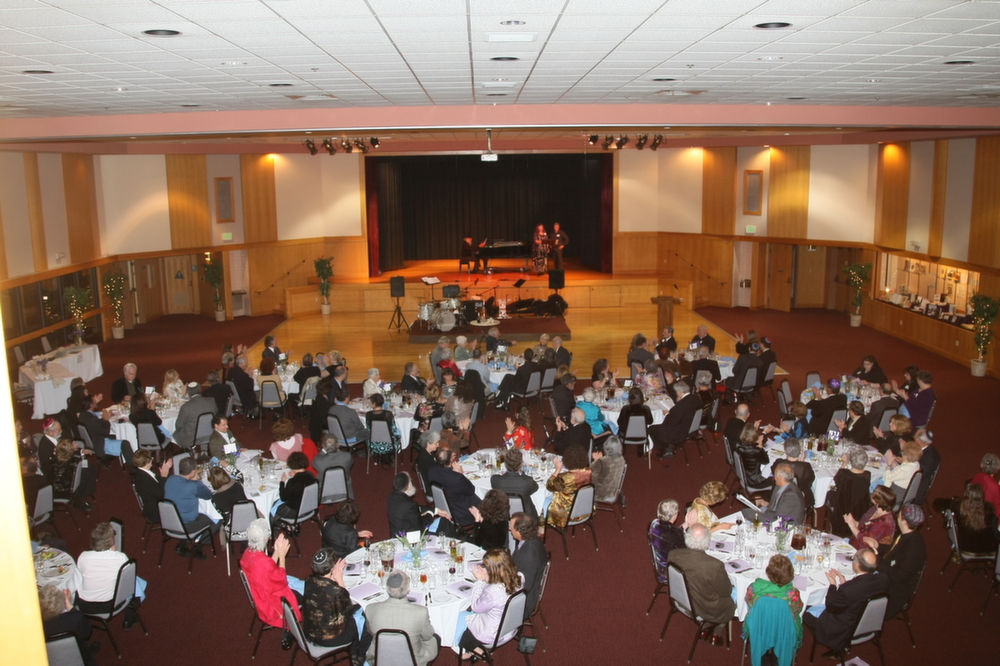
As you can see the picture below our DVD collection grew significantly. Now we have about 30 feature films for you to choose from. Each of them will be introduced one by one on this blog, but you can start borrowing them right away.

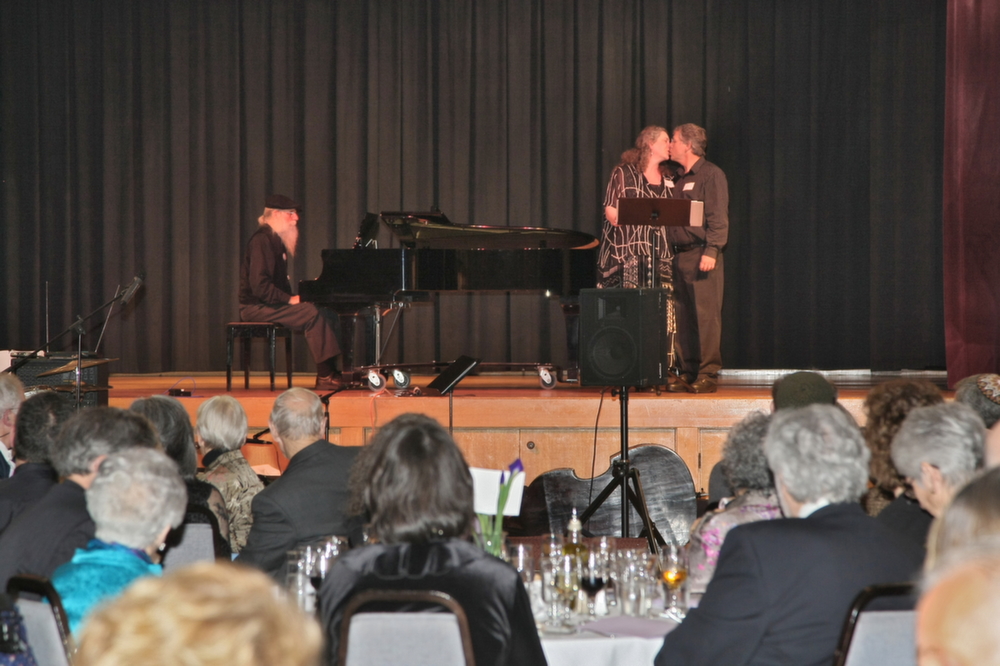
The great reorganization of our VHS is also finished. The photo below shows how our VHS tapes are organized on the news shelves. On the top right you see the feature films and on the top left the films with music, including musicals, song collections, sing-a-longs, and individual artists’ concerts. On the second shelf from the top are all the tapes created for children and their families. The bottom two shelves have the most extensive part of our VHS tape library: the documentaries. We are hoping that this separation by topic will make it easier for to you pick up a tape or two that interests you.
23rd November 2008, 05:48 am
One of the most melancholic children books I ever read was Eileen Bluestone Sherman‘s The odd potato: A Chanukah story. On the second page we learn that the Rachel, the young heroine’s mother has died 18 months earlier and ever since then her father has been depressed. Even the illustration, by Katherine Kahn, shows a man sunk into his armchair, looking unenergetic. The rest of the story revolves around Rachel getting an odd looking potato and turning it into a hannukiah, because she did not find the family menorah, cherished by her mother. By the end, this simple act, finding the beauty and utilizing a simple object to bring light to her home, Rachel manages to cheer up her father as well.
You can read the details about the history of the book, how it was first developed for an Emmy winning TV show, than a storybook, how it turned into a musical, eventually produced on Broadway and since 2005 you can even buy the album of the music. I personally found it a bit bleak, as the children, including Rachel’s younger brother, all looked and sounded sad. Once I learned that it is based on true events that happened during the Great depression, I understood why. Ultimately it is a heartwarming story with a lesson, but because of the subject matter it may not be suitable for the youngest of children.
20th November 2008, 05:02 am
The subtitle of Sadie Rose Weilerstein‘s K’Tonton in the Circus, a Hanukkah Adventure is slightly misleading. Only 8 of the book’s 85 pages are centered on Hanukkah. But that section is well integrated into the rest of the story that details Ktonton’s, a 4 inch tall boy’s adventures, when he was taken to a traveling circus. If you haven’t read any K’tonton book you are in for a treat. Weilerstein teaches Judaism, by intertwining Torah, haggadah, midrash, and even halakhah with other subjects, in this case the life of a circus. The reader learns about both, through the perspective of the boy who keeps kosher, says his prayers and even manages to celeberate Hanukkah with his newfound friends as the first Jewish person amongst them. There is even a reasonable (and Jewish) explanation why he seems so content and not missing his parents terribly. For a while.
A small line drawing of a circus animal by Marilyn Hirsh‘s starts off the chapters and she did a half or full page illustration for each of the 15 chapters. The book is not just educational in both areas (Judaism and circus life), but also a great and fun read. Enlightened readers might object to the living conditions and exploitation of the circus animals (and performers for that matter), but you might view the subject matter differently if you remember that it was written almost 30 years ago.
|